DHA Revalidation Under NFPA 660
Five-Year Review Requirements for Dust Hazard Analysis
Dust Hazard Analysis (DHA) became a formal requirement for many facilities following the introduction of NFPA 652, with most initial studies completed between 2016 and 2020. These early DHAs focused on identifying combustible dust hazards, documenting compliance, and establishing a baseline understanding of fire and explosion risks associated with particulate solids.
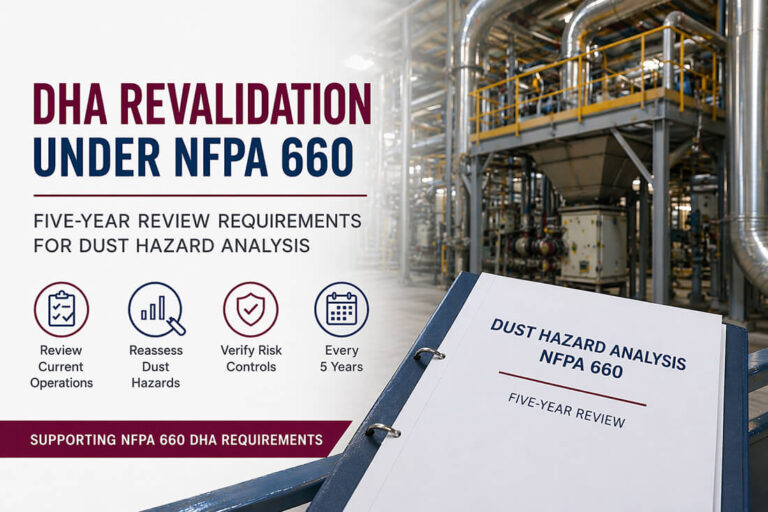
Dust Hazard Analysis (DHA) revalidation under NFPA 660 addresses how combustible dust risks evolve over time. Several years after an initial DHA is completed, facilities often operate under different conditions. Equipment may have been replaced or modified, production rates may have shifted, materials may no longer match original specifications, and housekeeping practices may have changed.
NFPA 660 reflects this reality by reinforcing that a DHA must remain representative of current operations and risks. A DHA that is not revisited becomes a historical document rather than an active risk management tool.
DHA revalidation is intended to close that gap. It is not a repetition of the original study and it is not simply an administrative update. It is a structured technical review that evaluates whether the assumptions, hazard scenarios, and controls documented in the original DHA still reflect how the facility actually operates today.
In this blog post, you will explore:
- NFPA 660 Requirements for DHA Revalidation
- Time-Based and Change-Based Drivers for Revalidation
- Scope and Intent of a DHA Revalidation
- Initial DHA vs. DHA Revalidation
- Role of Dust Testing in Revalidation
- Reviewing Dust Hazard Scenarios
- Reassessing Ignition Sources and Control Measures
- Evaluating Dust Accumulation and Housekeeping Practices
- Reviewing Fire and Explosion Protection Features
- Management of Change and Information Gaps
- DHA Revalidation Deliverables and Outcomes
NFPA 660 Requirements for DHA Revalidation
NFPA 660 carries forward the requirement that Dust Hazard Analyses be reviewed and updated at least every five years. This requirement applies regardless of whether significant incidents have occurred or whether major modifications are believed to have taken place. The intent is to recognize that combustible dust hazards are influenced by operating conditions that tend to drift over time.
NFPA 660 treats DHA revalidation as part of a broader hazard management framework. A current DHA supports inspection readiness, internal audits, insurance reviews, and day-to-day operational decision-making. A dated DHA, even if technically sound when written, no longer serves that function.
Time-Based and Change-Based Drivers for Revalidation
The five-year interval establishes a minimum expectation, not a maximum. In practice, many facilities benefit from partial reviews more frequently when changes occur. These changes do not always rise to the level of formal capital projects or process redesigns.
Common examples include incremental throughput increases, replacement of dust collectors with different airflow characteristics, changes in duct routing, or substitution of raw materials that appear equivalent but differ in particle size or moisture content. Over time, these gradual process changes can alter dust dispersion patterns, accumulation rates, and ignition susceptibility.
Revalidation allows operating experience, near-miss information, and gradual process changes to be reviewed together to evaluate their cumulative impact on combustible dust hazards.
In many facilities, these incremental changes accumulate over time without a single defining event, making periodic revalidation essential for identifying how conditions have shifted.
Expert Take: “No Change” Is a Technical Claim
It’s a common pitfall to assume "nothing changed" is a default setting for revalidation. In reality, saying "no change" is a technical conclusion that requires the same burden of proof as a new process. To survive a third-party review, you need the inspection records and operating history to back it up. If you can’t see the evidence, the change—or lack thereof—isn't verified.
Scope and Intent of a DHA Revalidation
A DHA revalidation focuses on confirming whether the original analysis remains technically valid. This includes reviewing hazard scenarios, assumptions, material data, and the effectiveness of safeguards. It also identifies areas where conditions have changed enough to require updated analysis or additional controls.
Unlike an initial DHA, revalidation typically builds on existing documentation. The process is targeted rather than exploratory. The emphasis is on validating what still applies, identifying what no longer applies, and addressing gaps that have emerged since the original study.
Initial DHA vs. DHA Revalidation
Feature | Initial DHA | DHA Revalidation |
Primary Objective | Establish baseline combustible dust hazards | Confirm whether documented hazards and assumptions remain valid |
Primary Data Sources | Design information, process descriptions, and initial dust testing | Initial DHA Report, Management of Change records, operating history, inspection findings, and incident history |
Technical Focus | Identification of all credible dust fire and explosion scenarios | Evaluation of changes, cumulative modifications, and operational drift |
Outcome | Foundational combustible dust safety assessment | Current, defensible dust hazard assessment aligned with NFPA 660 addressing all hazards |
Initial DHA vs. DHA Revalidation
Feature | Initial DHA | DHA Revalidation |
Primary Objective | Establish baseline combustible dust hazards | Confirm whether documented hazards and assumptions remain valid |
Primary Data Sources | Design information, process descriptions, and initial dust testing | Initial DHA Report, Management of Change records, operating history, inspection findings, and incident history |
Technical Focus | Identification of all credible dust fire and explosion scenarios | Evaluation of changes, cumulative modifications, and operational drift |
Outcome | Foundational combustible dust safety assessment | Current, defensible dust hazard assessment aligned with NFPA 660 addressing all hazards |
Role of Dust Testing in Revalidation
Material data forms the technical basis of any DHA. Revalidation includes a review of existing dust test data to determine if it remains representative of current materials and operating conditions.
Changes in particle size distribution, fines generation, moisture content, formulation, or supplier can affect explosibility, ignition sensitivity, and dispersion behavior. Even small changes in processing or handling conditions can alter dust characteristics enough to affect hazard assessments.
When existing test data no longer reflects current material properties, updated combustible dust testing may be required. Re-testing supports accurate hazard characterization and avoids reliance on outdated or non-representative material data.
Reviewing Dust Hazard Scenarios
Revalidation begins with a review of the dust hazard scenarios documented in the original DHA. These scenarios describe where dust is generated, how it may become airborne, where confinement exists, and how ignition could occur.
Changes in equipment layout, enclosure integrity, ventilation, or operating practices can affect these scenarios. For example, added access doors, modified transfer points, or changes in airflow balance can alter dispersion behavior. Areas that were previously considered low risk may become more susceptible to hazardous dust clouds or accumulations.
The review examines whether each scenario remains credible, whether likelihood assumptions still make sense, and whether consequences have changed due to modified confinement or equipment geometry.
Reassessing Ignition Sources and Control Measures
Ignition source control is a central element of combustible dust risk management. During revalidation, ignition sources are reassessed based on current equipment condition, maintenance practices, and operating experience.
Wear, misalignment, and changes in maintenance frequency can introduce ignition mechanisms that were not present during the original DHA. Electrical modifications, replacement motors, or changes in control strategies may also affect ignition potential.
The evaluation considers whether existing controls such as bonding and grounding, temperature monitoring, spark detection, and preventive maintenance practices still address identified ignition risks.
Evaluating Dust Accumulation and Housekeeping Practices
Dust accumulation is one of the most variable elements of combustible dust hazard management. Accumulation rates are influenced by production levels, ventilation effectiveness, enclosure condition, and cleaning practices.
During revalidation, housekeeping procedures and inspection records are reviewed alongside observed conditions in the facility. Elevated surfaces, concealed spaces, and structural members are reviewed to determine whether accumulation assumptions used in the original DHA remain valid.
Changes in staffing, cleaning methods, or production schedules can significantly affect accumulation patterns. Revalidation confirms whether accumulation thresholds are being controlled as intended and if housekeeping practices remain aligned with actual dust generation.
Reviewing Fire and Explosion Protection Features
Fire and explosion protection measures documented in the original DHA are reviewed to confirm they remain appropriate for current hazard conditions. This includes explosion venting, isolation, suppression, and fire detection systems, where installed.
Revalidation examines whether design assumptions such as protected volume, vent area, and isolation effectiveness still align with current equipment configurations and material properties. Modifications to ducts, enclosures, or process volumes can reduce the effectiveness of protection systems if not properly evaluated.
The review also considers maintenance and inspection practices for protection systems, as degradation over time can affect performance during an event.
Management of Change and Information Gaps
Revalidation often identifies gaps between formal Management of Change records and actual facility modifications. Informal changes, temporary workarounds, and gradual process adjustments may not have been captured through MOC systems.
The revalidation process reviews available MOC documentation and compares it to observed conditions. Where gaps are identified, hazards are reassessed based on the current configuration rather than the original design intent.
This step strengthens the connection between DHA findings and day-to-day operational decisions, improving the usefulness of the DHA as a living document.
SME’s Perspective: Mind the MOC Gap
We often see facilities pass their initial DHA with flying colors, only to fail a review later because of "minor" tweaks. The MOC (Management of Change) process often misses small equipment swaps or slight set-point adjustments that don't seem like a big deal at the time. Revalidation is your chance to catch these undocumented "drift" items before they turn into a documented finding or, worse, an incident.
DHA Revalidation Deliverables and Outcomes
A properly executed DHA revalidation provides a clear technical record of what remains valid, what has changed, and what additional actions are recommended. Rather than repeating original findings, recommendations focus on addressing new or modified hazards, or escalating hazards still presenting.
Typical deliverables include confirmation of still‑valid scenarios, updated hazard evaluations where changes have occurred, and prioritized recommendations that reflect current operations and controls. The updated DHA supports alignment with NFPA 660 and provides a documented basis for inspections, audits, and future changes.
DHA revalidation under NFPA 660 is a structured technical review grounded in how a facility operates today. It evaluates whether hazard scenarios, material data, and safeguards documented years earlier still represent current conditions. When approached methodically, revalidation supports continuity in combustible dust risk management and maintains alignment with regulatory and industry expectations.
Rather than treating revalidation as a compliance deadline, facilities benefit most when it is used to confirm assumptions, address incremental changes, and maintain an accurate understanding of dust hazards throughout the life of the operation.
Facilities seeking technical support with DHA revalidation, combustible dust hazard assessments, or material testing can contact Sigma-HSE to discuss scope, expectations, and technical approach.
Contact us at [email protected]
Call +1 (978) 880-5076