Hazardous Area Classification for Combustible Dust: Class II Locations
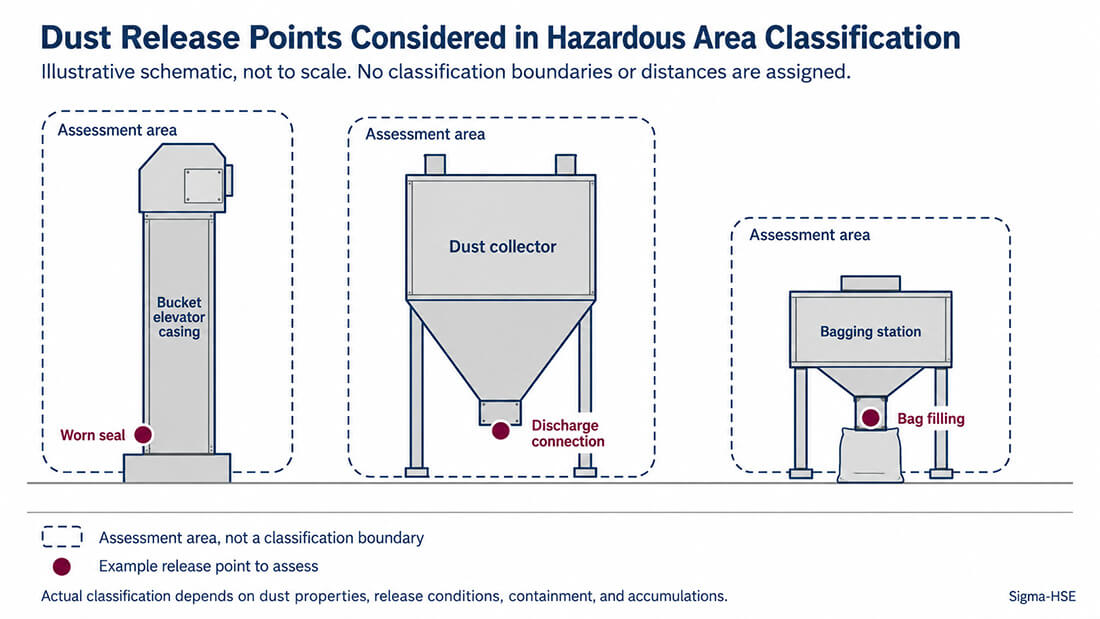
Dust escapes through worn bucket elevator seals, disperses during bag filling, and accumulates around leaking collector discharge connections. An airborne combustible dust cloud above its minimum explosible concentration can ignite when exposed to an electrical arc or a hot surface capable of igniting it. Deposits on motor frames restrict heat dissipation and raise operating temperatures.
For combustible dust processes, hazardous area classification (HAC) identifies where dust creates a hazard for electrical equipment and assigns each hazardous area a Class, Division, and dust Group. The evaluation covers dust releases and accumulations under normal and abnormal operating conditions. Those designations determine which electrical equipment and wiring methods are permitted. Equipment selection also depends on the dust’s cloud and layer ignition temperatures and the equipment’s maximum surface temperature.
In This Article
Class II Hazardous Locations
Class II Division 1 vs. Division 2
Class II Dust Groups E, F, and G
How Far Does a Class II Classified Area Extend?
Electrical Equipment for Class II Locations
Dust Hazard Analysis and Area Classification
When to Review a Hazardous Area Classification
Class II Hazardous Locations
Class II hazardous locations are areas where combustible dust creates a fire or explosion hazard for electrical installations. Grain handling, flour milling, and metal powder production are examples of processes that can give rise to Class II locations. Class I locations involve flammable gases or vapors, including vapors from flammable or combustible liquids. Class III locations involve easily ignitable fibers and flyings, such as cotton lint, that are not likely to be suspended in air in quantities sufficient to form ignitable mixtures.
Article 500 of NFPA 70, National Electrical Code (NEC), establishes the Class and Division framework for hazardous (classified) locations. Article 502 addresses Class II electrical installations, including wiring methods, equipment, sealing, and grounding. NEC references in this article are to the 2023 edition.
NEC Article 506 provides a separate dust classification system using Zones 20, 21, and 22. OSHA’s electrical standard, 29 CFR 1910.307, requires Division classification for Class II and Class III installations. This article focuses on the Class II Division framework.
Class II Division 1 vs. Division 2
Class II Division 1 covers ignitable dust clouds during normal operation, failures that could produce both an ignitable mixture and an ignition source, and hazardous quantities of Group E dust. Division 2 covers ignitable dust clouds from abnormal operation, dust suspended by infrequent equipment malfunction, and deposits that affect electrical equipment.
The conditions below summarize Section 500.5(C) of the 2023 NEC.
A Class II Division 1 location meets at least one of three conditions:
Combustible dust is airborne during normal operation in quantities sufficient to form explosive or ignitable mixtures.
Mechanical failure or abnormal operation of machinery or equipment could produce such a mixture and also provide an ignition source through simultaneous electrical equipment failure, operation of protective devices, or other causes.
Group E combustible dusts may be present in quantities sufficient to be hazardous under normal or abnormal operating conditions.
A Class II Division 2 location meets at least one of three conditions:
Abnormal operation could put combustible dust in the air in quantities sufficient to form explosive or ignitable mixtures.
Dust accumulations are normally insufficient to interfere with the normal operation of electrical equipment or other apparatus but could become airborne through infrequent malfunction of handling or processing equipment.
Accumulations on, in, or near electrical equipment could interfere with safe heat dissipation or could be ignited by abnormal operation or failure of that equipment.
Division 2 does not mean dust-free. Deposits already present on or near electrical equipment can meet the third Division 2 condition on their own.
Table 1: Class II Division 1 vs. Division 2
Factor | Division 1 | Division 2 |
Airborne dust | Ignitable quantities during normal operation | Ignitable quantities through abnormal operation |
Failure scenario | Could produce an ignitable mixture and an ignition source together | Infrequent malfunction could suspend existing accumulations |
Accumulations | Resuspended deposits are evaluated against Division 1 airborne-dust conditions | Could interfere with heat dissipation or ignite through abnormal electrical equipment operation |
Group E dust | Hazardous quantities under normal or abnormal conditions | Addressed under Division 1 |
Class II Dust Groups E, F, and G
Group E generally covers combustible metal dusts, Group F covers qualifying carbonaceous dusts, and Group G covers combustible dusts not in Group E or F. The groups separate dusts by the hazard each poses to electrical equipment. NEC Section 500.6(B) defines the groups, and NFPA 499 provides supporting guidance on dust grouping and hazardous area classification.
Equipment approval must cover the dust group present, and approval for one group does not establish suitability for another. Where a process handles several dusts, verify equipment suitability for every applicable group.
Table 2: Class II Dust Groups
Group | Dust type and examples | Classification and selection notes |
E | Combustible metal dusts, including aluminum, magnesium, and their commercial alloys, and other combustible dusts whose particle size, abrasiveness, and conductivity present similar hazards for electrical equipment | Hazardous quantities classify the location as Division 1. |
F | Combustible carbonaceous dusts, such as coal, carbon black, charcoal, and coke, with more than 8 percent total entrapped volatiles, or sensitized by other materials so that they present an explosion hazard | Confirm the volatiles content or sensitization criteria before assigning the group. |
G | Combustible dusts not in Group E or F, including flour, grain, starch, wood, plastic, and chemical dusts | Confirm the dust does not meet Group E or F criteria before assigning Group G. |
How Far Does a Class II Classified Area Extend?
There is no single classification distance that applies to every combustible dust process. Boundaries depend on dust properties, release sources, containment, and operating conditions, evaluated against the applicable classification criteria and NFPA 499 guidance.
The assessment starts with transfer points, dust collectors, conveying systems, and bagging stations. It examines how much dust escapes, how often, and where it travels during normal and abnormal operation. Enclosure integrity, discharge arrangements, dust extraction, airflow, and facility layout influence the extent of airborne dust and settled deposits. Where normal operation produces ignitable dust concentrations inside collectors, elevator casings, or silos, those interiors meet the first Division 1 condition. External boundaries require a separate assessment of releases and accumulations.
Deposits on beams, ledges, and equipment also matter because disturbance can suspend them in air. Housekeeping methods, frequencies, and accumulation limits affect the result, but meeting an accumulation limit alone does not establish that an area is unclassified.
Classification drawings typically show the boundaries and the applicable Class, Division, and dust Group. Supporting documentation records the operating conditions and assumptions used to establish those boundaries.
Electrical Equipment for Class II Locations
Electrical equipment must be suitable for the location’s Class, Division, dust Group, and temperature requirements. Some equipment and wiring methods permitted in Division 2 are not permitted in Division 1. For example, NEC 502.115(B) permits dusttight enclosures for switches, circuit breakers, and motor controllers in Division 2.
Can Class I Rated Equipment Be Used in Class II Locations?
A Class I rating alone does not establish suitability for combustible dust environments. Explosionproof construction is primarily intended to address ignition hazards associated with flammable gases and vapors. However, a Class I rating does not, by itself, demonstrate adequate protection against combustible dust ingress, dust accumulation, or the associated ignition risks arising from elevated surface temperatures. Suitability for combustible dust environments must therefore be separately verified against the applicable dust-related equipment requirements.
Check the equipment’s approvals, markings, and installation instructions for the Class II application. Equipment approved for both classes must be suitable for the gas and dust groups present. Where both hazards occur together, evaluate the combined exposure, temperature limits, and installation conditions.
Temperature Limits and Protection Methods
Check the dust’s cloud and layer ignition data against the equipment’s temperature marking and conditions of use. Dust layers restrict heat dissipation, so the evaluation must account for accumulation and operating conditions.
NEC 500.8(D)(2) requires the temperature marking to be below the specific dust’s ignition temperature. For organic dusts that can dehydrate or carbonize, the marking must not exceed the lower of the ignition temperature or 165°C (329°F).
Dust-ignition proof construction excludes dust and prevents internal arcs, sparks, or heat from igniting surrounding dust. Other approaches include dusttight construction, intrinsic safety, and pressurization where permitted for the equipment and classified location. NEC 500.7 addresses protection techniques.
Dust Hazard Analysis and Area Classification
A dust hazard analysis (DHA) evaluates fire, flash fire, and explosion hazards in processes and facility areas under NFPA 660 and identifies safeguards. Hazardous area classification (HAC) addresses electrical ignition hazards by defining classified locations and the requirements for electrical equipment and wiring.
Both draw on information about where dust is released, where it settles, and how the process behaves during normal and abnormal operation. When DHA recommendations lead to changes in containment or dust collection, review the classification and update drawings and supporting documentation where conditions have changed. A DHA can also recommend a classification study where electrical equipment is a potential ignition source and no current classification exists. Neither assessment replaces the other.
When to Review a Hazardous Area Classification
Review a hazardous area classification when a change affects dust properties, releases, or accumulations. Triggers include:
A new material with a different dust Group or ignition temperature
A new collector or a relocated transfer point
Higher throughput
Modified containment
Changes to cleaning practices
Layout changes
Route these changes through management of change so the review happens before implementation.
A fire, flash fire, explosion, near miss, or unexpected dust accumulation outside documented classified boundaries also warrants review. Where classification documentation is missing or no longer reflects current conditions, assess the process as it operates today and document the classification.
Sigma-HSE’s technical team prepares hazardous area classifications for new and existing facilities handling combustible dust. To discuss your facility, have your process description, dust types, and any current classification documents ready.