Dust Hazard Analysis Checklist and Management Framework
Combustible dust can create serious fire and explosion hazards when several conditions come together. The dust explosion pentagon illustrates the five elements required for a dust explosion: fuel, oxygen, an ignition source, dispersion, and confinement. When all of these conditions are present, fine particles can ignite and produce an explosion. An initial event may also disturb accumulated dust, creating the potential for a more severe secondary explosion.
A Dust Hazard Analysis (DHA) helps facilities identify where these hazards may develop and evaluate the safeguards already in place. For safety leaders, process owners, engineers, and facility managers, a DHA provides a structured approach to assessing risk and prioritizing practical improvements.
The dust hazard analysis checklist below covers key areas to consider when preparing, conducting, documenting, and maintaining a DHA. The steps provide a flexible framework, as findings in one area may lead to further evaluation in another.
Core Elements of a Dust Hazard Analysis Checklist
A comprehensive DHA should examine how material behaves within the process, where hazardous conditions can develop, what could initiate an event, and how existing safeguards address credible scenarios. The following ten areas provide a practical framework for conducting that evaluation.
1. Define the Purpose and Scope
A DHA evaluates processes and areas where combustible particulate solids could create fire, flash fire, or explosion hazards. The assessment examines credible scenarios, existing safeguards, and opportunities for risk reduction.
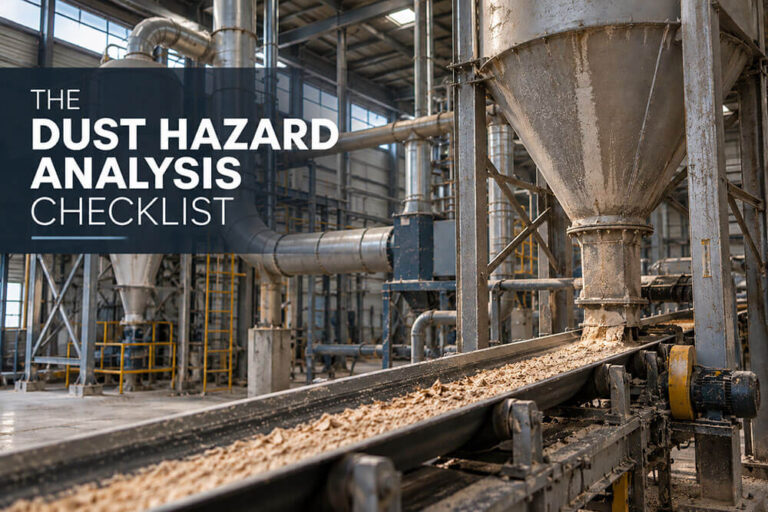
The scope may cover equipment that generates, handles, processes, transfers, collects, or stores combustible material. Depending on the facility, this could include dust collectors, mills, grinders, dryers, mixers, silos, bins, conveyors, pneumatic conveying systems, and transfer points.
The analysis should also consider the broader process environment. Fugitive releases, accumulated material, interconnected processes, building conditions, and propagation pathways can influence event severity. Establishing assessment boundaries at the outset helps the team systematically evaluate the process and document the basis for its conclusions.
2. Understand NFPA 660 and OSHA Requirements
The combustible dust standards landscape has changed with the publication of NFPA 660, Standard for Combustible Dusts and Particulate Solids. NFPA 660 consolidates requirements previously distributed across several NFPA standards, including NFPA 652 and commodity-specific standards such as NFPA 61, NFPA 484, NFPA 654, and NFPA 664.
Facilities should understand how the current NFPA framework applies to their materials, processes, equipment, and DHA documentation. Local codes, Authorities Having Jurisdiction (AHJs), insurance requirements, and facility- or company-specific standards may add other considerations.
Although there is no single federal OSHA combustible dust standard, OSHA can address these hazards through existing regulations and the “General Duty Clause”. Applicable NFPA requirements may also represent recognized and generally accepted good engineering practices (RAGAGEP), which can also be referenced in OSHA findings.
3. Choose a DHA Approach and Hazard Analysis Method
A DHA may use a prescriptive or risk-based methodology based on the facility and complexity of its hazards.
A prescriptive approach evaluates processes and safeguards against applicable NFPA requirements. This can provide a practical path for facilities with relatively straightforward processes and well-understood hazards.
Risk-based approaches evaluate scenarios through formal risk assessment and may be valuable for complex operations, unusual process conditions, or cases where prescriptive solutions do not adequately represent actual risk.
Techniques such as What-If analysis, Hazard and Operability Study (HAZOP), Fault Tree Analysis (FTA), and Layers of Protection Analysis (LOPA) may support a risk-based assessment. The final DHA should clearly document the selected methodology, assumptions, scenarios, and basis for recommendations.
4. Form the DHA Team and Map Dust Hazards
An effective DHA depends on technical expertise and detailed facility knowledge. A multidisciplinary team can bring together process safety, operations, engineering, maintenance, and EHS perspectives.
Before the facility walkthrough, information around the process and existing safeguards needs to be gathered. Relevant materials may include process flow diagrams, equipment drawings, safety data sheets, previous testing, incident records, operating procedures, and documentation for protection systems.
The team can then map where dust is generated, transferred, processed, collected, and stored while identifying potential release and accumulation points.
Scenario development is central to this stage. Instead of simply documenting the presence of combustible material, the analysis considers how a fire, flash fire, or explosion could occur and how an initial event could propagate through connected equipment or disturb accumulated dust.
5. Identify and Characterize Combustible Dusts
Understanding material properties provides a technical foundation for evaluating fire and explosion hazards.
Representative samples should reflect the material as it exists within the process. Particle size, moisture content, composition, and process conditions can influence combustible dust behavior.
Testing through an appropriately accredited laboratory using recognized methods can provide data needed for the DHA. Depending on the material and assessment objectives, relevant parameters may include:
- Kst, which characterizes the rate of pressure rise during a dust explosion
- Pmax, or maximum explosion pressure
- MIE, or the Minimum Ignition Energy
- MEC, or the Minimum Explosible Concentration
- MIT Cloud, or the Minimum Ignition Temperature of a dust cloud
- MIT Layer, or the Minimum Ignition Temperature of a dust layer
Not every DHA requires every available test. Testing should address specific process safety questions. Explosion severity data can support protection decisions, while ignition sensitivity data can help evaluate credible ignition scenarios.
6. Evaluate Dust Dispersion, Accumulation, and Ignition Sources
Combustible material alone does not define the hazard. A DHA should examine how dust could become dispersed, where it can accumulate, and what could ignite it.
Dust released from process equipment may form a hazardous cloud near the release point or move into surrounding areas. Accumulation on floors, beams, equipment, ductwork, and elevated or concealed surfaces also requires attention. An initial event may disturb that accumulated material and contribute to a more severe secondary explosion.
Next, the DHA should evaluate credible ignition sources, including electrical equipment, hot surfaces, overheated bearings, mechanical friction, sparks, electrostatic discharges, and hot work.
Material-specific data can strengthen this analysis. MIE data, for instance, can support the evaluation of electrostatic ignition hazards, while MIT data may inform assessments involving hot surfaces or heated equipment.
7. Evaluate Control Measures and Explosion Protection
Once hazards have been identified, existing control measures should be evaluated to determine where additional protection may be appropriate.
Prevention begins with limiting dust releases and controlling potential ignition sources. Dust collection, containment, equipment maintenance, electrical classification, bonding and grounding, operating procedures, and housekeeping may all contribute to the facility’s basis of safety.
Where explosion hazards exist within equipment, engineered protection may also be necessary. Depending on the application, strategies can include explosion venting, suppression, containment, and isolation.
Interconnected equipment requires particular attention. An explosion originating in one piece of equipment may propagate through ductwork, conveyors, or other connections. A protected dust collector, for instance, cannot necessarily be evaluated independently of connected equipment. Isolation and other propagation controls should therefore be considered within the complete scenario.
Protection strategies should reflect material characteristics, equipment configuration, process conditions, occupancy, and identified hazards, not simply applying a single solution across every application.
8. Prioritize Corrective Actions and Management of Change
A DHA becomes most valuable when its findings lead to practical action.
Recommendations should be prioritized according to identified hazards and the risk associated with each scenario. Higher-risk deficiencies may require prompt attention, while other improvements can become part of longer-term engineering or maintenance plans.
Each action should have an assigned owner, target completion date, and documented path to closure. Appropriate interim controls may also be needed when permanent modifications require engineering, procurement, or capital investment.
Management of Change (MOC) should connect directly to the DHA. Changes involving raw materials, equipment, operating conditions, dust collection systems, facility layouts, or production rates can introduce new scenarios or alter previous assumptions.
9. Plan for DHA Review and Revalidation
A DHA should evolve with the facility. Periodic review provides an opportunity to determine if materials, equipment, process conditions, or safeguards have changed since the previous analysis. Because of this, NFPA 660 and NFPA 652 require regular reviews every five years.
Applicable NFPA requirements call for DHA review and revalidation at defined intervals. Significant modifications may also warrant evaluation before the normal revalidation cycle.
Incidents and near misses can provide another reason to revisit the analysis. Lessons from these events may reveal previously unidentified scenarios, potential weaknesses, or assumptions requiring additional investigation.
10. Document DHA Findings and Deliverables
Clear documentation creates a record of the DHA findings and the actions taken in response. The final report should capture key findings and prioritized recommendations, with drawings, photographs, laboratory reports, or equipment information included where they add useful context.
Facilities should maintain DHA records and corrective-action documentation to support future reviews, revalidation, and applicable compliance requirements. Documentation should also align with OSHA’s Hazard Communication Standard. Where combustible dust presents a classified hazard, applicable hazard communication requirements – including labeling and safety data sheets – should be addressed within the facility’s broader safety program.
Managing Combustible Dust Hazards with Sigma-HSE
Managing combustible dust requires a clear understanding of both the material and the process in which it is handled. At Sigma-HSE, we combine process safety consulting with accredited laboratory testing to help facilities evaluate their hazards and make informed risk-management decisions.
Our team supports prescriptive and risk-based Dust Hazard Analyses, alongside combustible dust testing for parameters such as explosion severity and ignition sensitivity. By connecting laboratory data with facility-specific process conditions, we help clients identify credible hazards and develop practical recommendations for reducing risk.
If your facility needs a new DHA, is preparing for revalidation, or requires additional testing to support an existing assessment, our team can provide the technical expertise needed to move from hazard identification to informed action. Reach out today to discuss your combustible dust safety needs.